A Centre-Back Who Steps Into Midfield or One Who Holds the Line?
Stepping centre-back vs holding the line: see how each choice affects midfield access, cover behind the defense and the spaces an opponent can target.
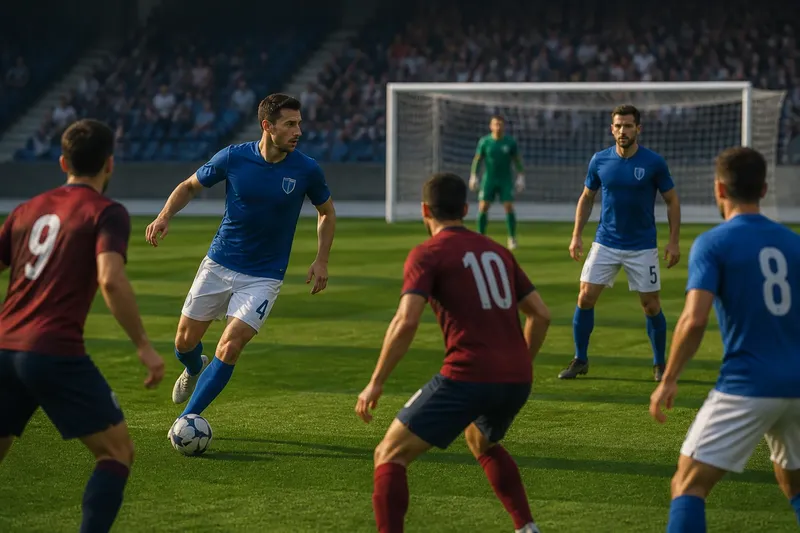
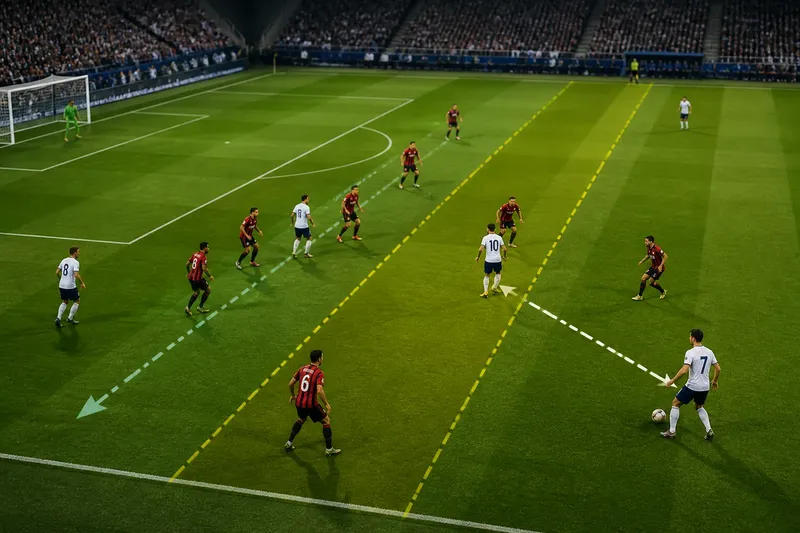
A forward checks toward midfield, and a centre-back considers following him. If he goes, his partner may need to protect the channel; if he stays, the forward may receive facing goal. Reading stepping centre-back vs holding the line means noticing the cue and the cover, not assuming either defender has a fixed response.
The basic choice
A stepping centre-back leaves the defensive line to move toward the ball or take up a higher position. He might advance with possession, offer a passing option beside a midfielder, or follow an opposing forward who drops away from the front line. “Stepping” describes a choice in a particular moment, not a permanent position.
A centre-back who holds the line generally preserves his place behind the play. He can still close a nearby receiver or move forward when the situation calls for it. The distinction is about his starting responsibility: engage the play farther upfield, or prioritize the space behind the defense.
The roles can complement each other, but they do not form an automatic pattern. If one defender follows a dropping forward, the partner may hold position and shift across to cover. If the holding midfielder fills the gap, the second centre-back may also step; the right response depends on the opponent’s runners and the space left open.
Why step forward
With the ball, a centre-back who advances can give the team an extra player in midfield. If an opponent’s forward blocks the route to a central midfielder, the defender may carry past that first obstacle and force another opponent to decide whether to leave a teammate. A forward pass can then reach a player who was screened.
Without the ball, stepping can prevent a receiver from turning. A defender may move toward a striker who has dropped into the space ahead of the back line, aiming to meet him before he faces forward. The action can disrupt a pass-and-turn combination, but it also removes a defender from the line for a moment.
The useful cue is not simply that the ball is nearby. The defender must judge whether a teammate can cover the space he leaves, whether the receiver is likely to control the ball cleanly, and whether an opponent is ready to run beyond him. A step that arrives with the pass can crowd the receiver; a late one can leave the defender chasing from behind.
What the partner protects
A centre-back who holds the line gives the defense a reference point behind the stepping player. He can watch the striker, protect the route toward goal and prepare to cover a runner. Holding position does not mean standing still: he may need to slide toward the open channel or drop as the team’s line adjusts.
His cover depends on the players around him. A fullback tucking inside, a defensive midfielder staying goal-side, or a goalkeeper positioned to sweep can add another layer. If those players are occupied elsewhere, the holding centre-back may be the only defender between an attacker and a clear run toward goal.
Describe the pair, not just the stepping defender’s forward movement. Ask who protects the space behind him and whether that cover has a useful angle to defend a pass into the channel. A partner who stays in the line can help only if his position and the team’s movement let him reach the danger.
The space trade
Every step changes the map. The advancing defender may create a passing lane in front of the opposition midfield, but the space he vacates can become a target if possession is lost. The question is whether nearby players can keep the ball or delay a counterattack.
Opponents can respond in different ways. A striker may stay high to occupy the holding defender while a midfielder moves into the gap left by the stepping player. Or the striker can drop to draw a defender out, with a teammate ready to run beyond. The same movement can be a decoy in one sequence and a direct invitation to press in another.
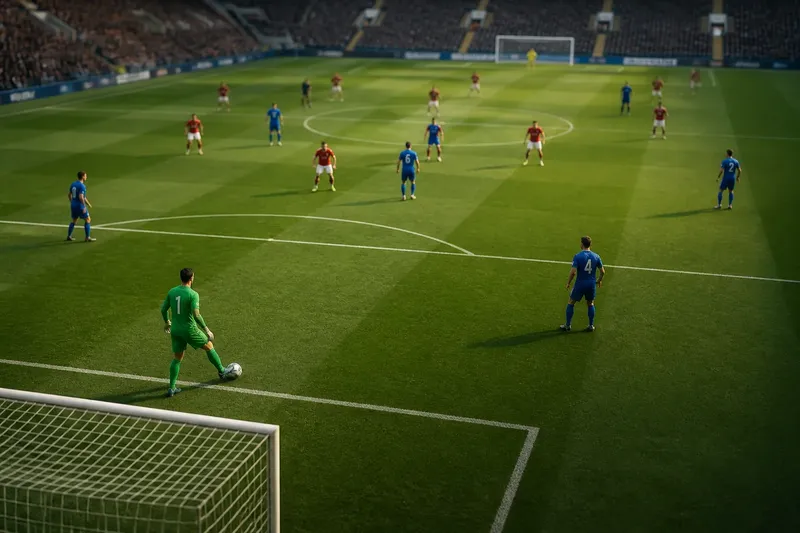
Imagine a team building from the back against two forwards who screen its central midfielders. Its right centre-back carries forward as one forward hesitates. The left centre-back stays behind, while the right midfielder moves closer to offer a short pass. The expected result is a route through the first press, with the left centre-back watching the striker and ready to cover a turnover. If the midfielder is marked and the opposing winger is poised to break, the carry could instead expose the right channel.
Reading the matchup
Look at the opponent’s front line before predicting whether a defender will step. Against a lone striker, the partner may have room to monitor him while a centre-back follows a dropping receiver. Against two forwards, moving one centre-back away can leave the other facing a direct overload unless a midfielder drops back or a fullback narrows in.
The receiver’s body shape matters, too. A player facing his own goal is less immediately dangerous than one already turned toward the defense, though a poor pass or uncertain first touch can change the picture. Timing depends on both the receiver and the teammates positioned to cover.
Team behavior matters as much as individual preference. A defender may follow a dropping forward only if the holding midfielder fills the gap; if that midfielder is occupied, the centre-back may need to hold his position instead. In a preview, describe the condition and the likely adjustment rather than presenting either role as automatic.
Questions about the roles?
Does a stepping centre-back become a midfielder?
Not necessarily. He can enter midfield briefly to support a build-up or challenge a receiver, then return to the defensive line as the ball moves. His responsibilities, rather than his temporary position, define the role.
Can both centre-backs step forward?
They can if another player covers the central space or the team moves together to protect it. If both advance without cover, an opponent may attack the space behind them with a pass or a forward run.
How can I spot a defender holding the line?
Watch what he does when a forward drops toward the ball. If his partner follows and he stays goal-side, shifting across to protect the channel, he is holding the line in that moment. If he follows too, another player may be covering the space or the defense may be using a different rotation.
Is stepping always more aggressive?
It moves the defender forward, but it is not automatically the riskier choice. A timely step can stop a receiver from turning, while holding position can invite an opponent to advance into pressure.
What to note in a preview
Connect the defender’s movement to the opponent’s likely response. For each observation, decide what it would mean for your preview:
- The cue: If the centre-back follows when a striker drops, describe that trigger; if he waits for the pass, note the later engagement instead.
- The cover: If a midfielder or fullback fills the vacated space, identify that support; if neither does, flag the channel as a possible target.
- The ball: If the receiver can retain possession after the step, describe the pressure the defender may create; if a turnover would leave a clear route forward, mention the counterattacking risk.
- The runner: If a forward or wide player is ready to run behind, explain who must track him; if no runner is positioned there, focus on the receiver’s chance to turn.
- The partner: If the second centre-back slides across, note how that may close the channel; if he remains central, consider which teammate must cover the wider space.
- The line: If the rest of the defense moves up together, describe the space they leave behind; if the line stays deep, note the gap that may open between defense and midfield.
These details keep a role description tied to the match rather than turning it into a label. “The centre-back steps out” is an observation; “his partner must cover the channel if the forward spins away” explains the consequence.
When you assess stepping centre-back vs holding the line, focus on the exchange: what the team gains ahead of the ball, what it leaves behind, and who is responsible for the space in between. In a preview, naming the condition that changes the defender’s choice gives the reader a clearer picture of how the matchup may unfold.