The Overlap and the Underlap Are Not the Same Run
Overlap vs underlap: see how each supporting run changes a defender’s choices, shapes passing lanes, and gives you a clearer way to read a football matchup.
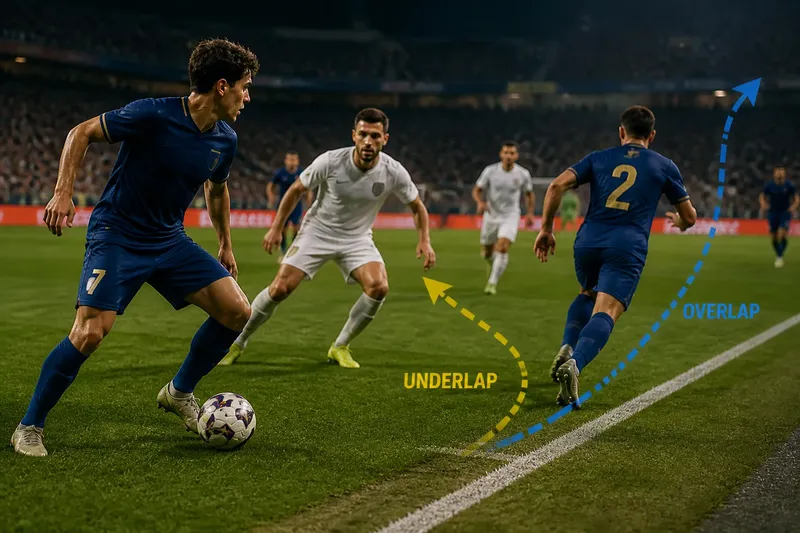
A winger cushions the ball by the touchline while a teammate begins a supporting run. If that runner passes on the winger’s outside, it is an overlap; if the runner cuts inside, it is an underlap. The difference helps you read which lane the attack is offering and which defender may have to respond.
Overlap vs underlap routes
The distinction is the runner’s path in relation to the teammate carrying the ball. An overlap goes outside the ball carrier, toward the touchline or the space beyond a fullback. An underlap cuts inside, often through the channel between a fullback and a center-back.
Neither term describes a formation or predicts what will happen next. Each names a movement. It becomes a matchup when defenders decide whether to follow the runner, hand that responsibility to a teammate, or stay with the ball.
Look at the route, not only the runner’s position. A fullback can overlap from behind a winger, while a midfielder can make an underlap from deeper in the field. The decisive clue is where the runner travels as the ball carrier approaches a defender.
Outside-lane options
An overlap offers a route around the defender. If the defender closes down the winger, a pass into the runner’s path may lead toward the byline, where a cross or cutback could follow. If the defender tracks the runner, the winger may have more room to turn inward or carry the ball.
The run can stretch the defense toward the touchline, provide a nearby outlet, or create a crossing angle. It may be harder to use if the runner has little room ahead or another defender already covers the outside lane.
Timing matters because the ball carrier needs a usable passing angle. If the runner goes too soon, defenders may have time to pass the marking responsibility along; if the run comes later, the defender may have less time to react, but the ball carrier still needs to see and reach the runner.
Inside-channel options
An underlap offers an inside route, perhaps toward the penalty area or a central shooting lane. The runner may draw a center-back away from the winger, offer a pass through the defensive line, or arrive in a pocket for a low ball played backward.
The movement asks defenders to protect a different space. A fullback who follows the runner inward may leave the outside lane open; a center-back who shifts across may leave another attacker room. But an underlap can meet traffic if defenders stay compact or the pass is forced.
For the ball carrier, the run can create a brief choice: protect the winger’s feet or check the runner cutting behind. The ball carrier might slip a pass inside, continue down the line, or pause with possession. The run presents options; the available lane and defensive response shape the next action.
Defensive handoffs
A fullback is often the first defender facing a choice between the ball and the runner. Against an overlap, that defender may stay with the winger or turn to chase the outside run. Against an underlap, the defender may follow the runner inward or hold the flank.
The fullback does not always make that choice alone. A center-back can cover an underlap, while a wide midfielder can track an overlap and allow the fullback to stay with the ball. Teams use different marking and handoff rules, so describe the likely dilemma rather than assuming every defense reacts alike.
Look for the nearest cover defender as well as the first marker. If a teammate is close enough to take the runner, the defender facing the ball may hold position. If cover is farther away, the run may ask the defense to make a more difficult handoff.
Reading the matchup
Track three details together: the ball carrier’s facing direction, the supporting player’s route, and the defender who turns or shifts. A run can matter even without a pass if it draws a marker away. A visible runner may have little effect, though, if the defense already covers the lane.
Say a right winger receives the ball near the touchline and a right back runs around the outside. If the opposing fullback turns toward the runner, the winger may have room to drive inside; if a covering midfielder takes the runner, the fullback may stay close to the ball. In this invented situation, the run does not decide the outcome by itself: the defensive handoff helps determine which option remains.
When writing or reading a preview, name the trigger and the choice instead of declaring a winner. An outside run could test whether the opposing wide player tracks back; an inside run could ask a center-back to shift across. Then check whether the ball carrier has a passing lane and whether another attacker occupies the space the runner leaves.
- Check whether the runner passes outside or inside the ball carrier; if the route goes outside, read it as an overlap, and if it cuts inside, read it as an underlap.
- Check whether the ball carrier can see the runner; if the lane is visible, a pass may be available, and if a defender blocks it, look for a carry or a pass elsewhere.
- Check whether the first defender follows the runner; if that defender leaves the ball, watch for space near the ball carrier, and if they hold position, look for cover from a teammate.
- Check whether a second defender is close enough to take over; if so, note a possible handoff, and if not, watch whether the first defender must choose between the runner and the ball.
- Check whether another attacker occupies the space opened by the run; if so, the defense may have to account for both threats, and if not, the defense may be able to shift across.
- Check whether the runner has room ahead; if the lane is open, note a possible route toward the byline or inside channel, and if it is crowded, look for a supporting pass or retained possession.
Questions about the runs?
Can one run count as both?
A continuous run can change direction, but the terms describe its route relative to the ball carrier at a particular moment. Name the decisive part: passing around the outside is an overlap, while cutting inside is an underlap.
Does an overlap have to come from a fullback?
No. Any supporting player can make an outside run past the ball carrier, although a fullback is a familiar example. Identify the route and its relation to the ball rather than relying on the player’s position.
Does an underlap always lead to a pass into the box?
No. It can offer an inside pass, draw a defender inward, or create room for the ball carrier to keep possession outside. Its usefulness depends on the lane and the defense’s response.
What should I watch after the run?
Watch whether the ball carrier uses the runner, whether a defender follows, and who covers the space that opens. Those details reveal how the movement shapes the matchup.
Useful preview language
Overlap vs underlap is a useful distinction because the routes threaten different spaces: one goes outside, while the other cuts inside. Connect the movement to the ball carrier’s options and the defenders’ cover, and your preview can describe the tactical question without pretending the run settles it.