From Goal Kick to First Press: Reading a Football Build-Up
Read a football build-up from goal kick to first press, spotting passing outlets and pressure cues so you can follow how teams adapt their opening route.
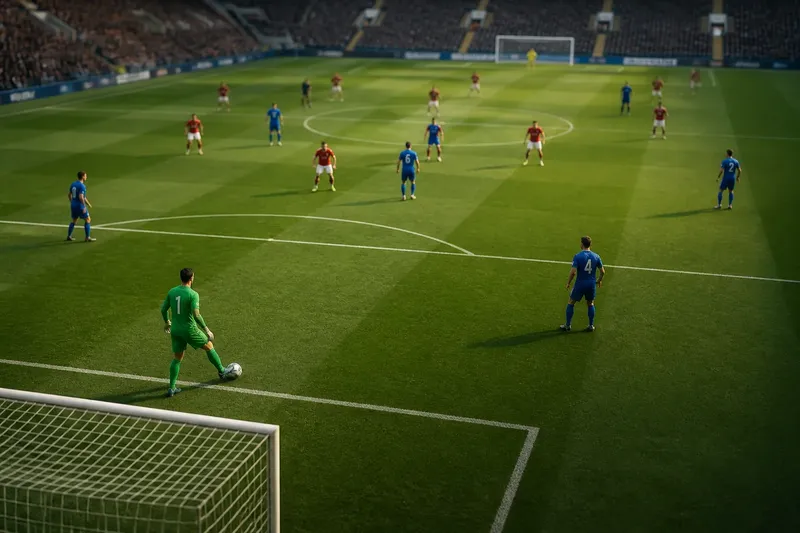
The goalkeeper sets the ball for a goal kick as the opposing forwards spread across the top of the penalty area. To read a football build-up, watch the defenders’ positions, the midfielder showing for the ball, and the nearest opponent preparing to press. Those opening cues reveal possible routes without predicting which one the team will choose.
Start at the restart
A goal kick gives the defending team a settled moment to arrange its first passing options. The goalkeeper might roll the ball to a nearby defender, pass into a midfielder, or kick toward a forward. The choice depends on the opponents’ positions, the players’ comfort on the ball, and the space beyond the first line.
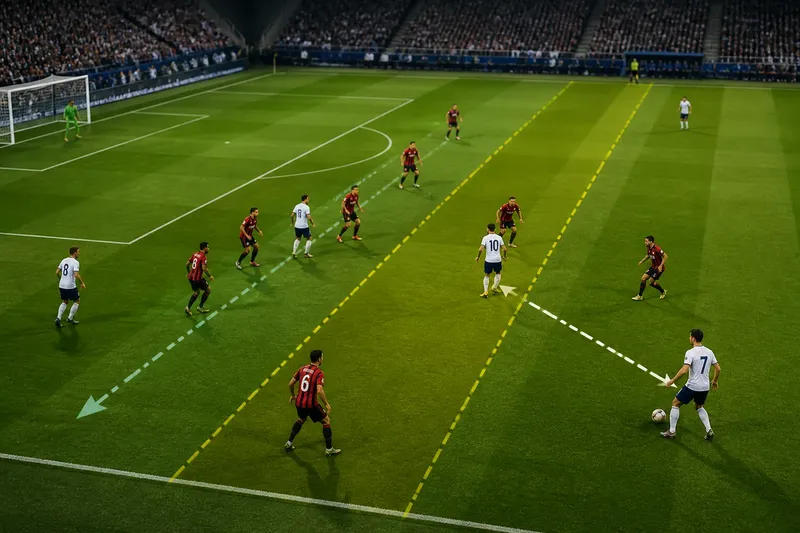
Locate the two center backs and fullbacks. Are the center backs close together or spread wide? Are the fullbacks near the touchlines, tucked alongside the center backs, or already higher up the field? Their positions suggest how many short routes are available and how much room remains for midfielders.
Then check the goalkeeper’s body position. Facing one side may make a pass there easier, while extra touches or a scan across the pitch may mean the goalkeeper is waiting for a teammate to move. Treat posture as a clue, not a verdict: the target can change when the press shifts.
Map the first outlets
Follow likely routes rather than trying to track every player. The ball may travel from the goalkeeper to a center back, then to a fullback and a midfielder. Another route may bypass the midfielder and reach a forward who can hold the ball or contest a pass in the air.
Notice whether a midfielder comes toward the ball or stays higher. A player dropping between or beside the defenders offers a short outlet, but may also draw an opponent away from the middle. A midfielder staying beyond the first press can provide a forward option if the team passes through or over the nearest defenders.
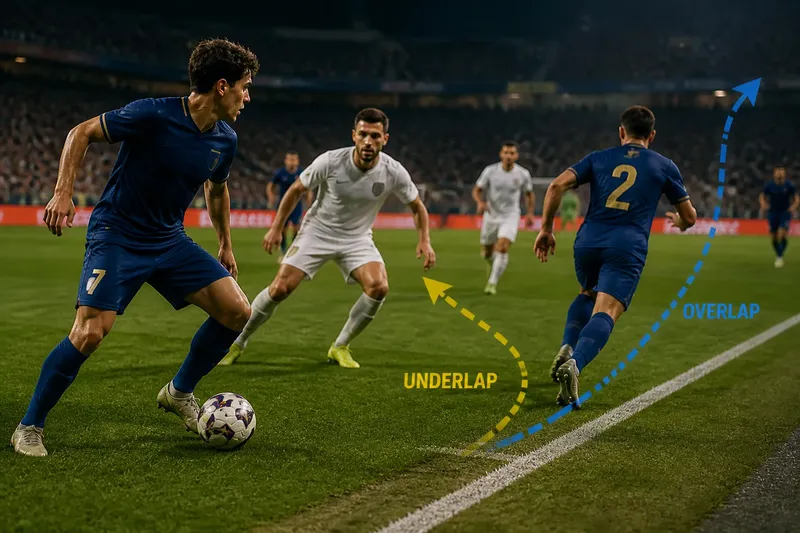
Fullbacks offer useful reference points. If both remain deep, they may provide extra short options. If one moves forward early, the team may be preparing to use a winger or midfielder on that side for a longer pass. Watch when the fullback moves in relation to the ball and the opponent’s first run.
Find the press trigger
The opposing team’s shape helps explain which outlet the build-up may be trying to reach. Two forwards might split to cover the center backs while a midfielder blocks the central route. A lone forward may angle a run toward one defender, encouraging a pass toward the touchline where teammates can close down the receiver.
Watch for the first coordinated movement. If the goalkeeper passes left and the opposing winger immediately sprints at the left center back, that pass may have triggered the press. If the winger holds position while a central midfielder steps forward, the opponent may be protecting the central route and leaving another pass available.
A press is not just a chase toward the ball. Players can screen a passing lane, making an apparently open teammate difficult to reach. Follow the receiver’s options: can the defender pass forward, switch to the other center back, or return the ball to the goalkeeper? Those choices show whether the press has restricted the build-up or simply prompted a safe adjustment.
Follow the game phases
Use the first few passes as a viewing routine. On the goal kick, scan the goalkeeper, back line, and midfield outlets. As the ball travels, shift attention to the nearest presser and the next available pass. After the ball crosses the first line, look upfield to see whether the receiver has support or is isolated.
When the ball goes long, keep watching the players underneath it. A forward may challenge for the pass while teammates move toward the likely landing area. The second ball can matter as much as the first: midfielders close enough to collect a loose ball may indicate that the long pass is a planned route rather than a hurried clearance.
When a short route breaks down, note how the team resets. The goalkeeper may switch to the opposite center back, a defender may return the ball to create a new angle, or the team may send a longer pass toward the sideline. These changes reveal which options remain after the opponent blocks the initial route.
When does a short pass invite pressure?
What does a goalkeeper’s return pass reveal?
A return pass can give the goalkeeper a fresh angle or draw the press toward one side before a switch. Watch whether defenders and midfielders move to offer new routes; if they stay still, the pass may leave the same problem in place.
How can you spot a covered midfielder?
A midfielder may look free but still be screened by an opponent standing between the ball and the receiver. Check the passing line, not just the distance between players, and watch whether the midfielder changes position to create a clear angle.
What if the team skips the midfield?
A pass over the first line can target a forward, a winger, or open space behind the press. Follow the supporting players after the kick to see who can gather a knockdown or challenge for the next ball.
Does the first goal kick define the whole match?
No. A team may choose a short restart once and a long one later, particularly as the opponent changes its press. Treat the opening shape as evidence of options in that moment, not a fixed description of the team’s approach.
Compare later restarts
One sequence may reflect a particular matchup or a mistake, so compare it with the next goal kick or a similar restart. Does the same midfielder drop? Does the goalkeeper keep choosing the same side? Does the opposition press in the same way? Repeated cues help distinguish a deliberate route from a one-off adjustment.
Say you are watching an invented team whose right center back receives the first pass while its holding midfielder stays behind the opponent’s forward line. The opposing winger rushes at the defender, so the center back returns the ball to the goalkeeper. The goalkeeper then switches left, where the left fullback has moved into space. The observable result is a new passing lane away from the pressure; it is evidence of the sequence, not proof of what the coach intended.
- Observe whether both center backs spread apart; if they do, watch for a pass into a wider lane, but if they stay close, track the fullbacks as the short outlets.
- Observe whether a midfielder drops beside the defenders; if so, check whether an opponent follows, but if the midfielder stays high, watch for a pass beyond the first press.
- Observe whether the nearest forward angles a run toward one center back; if so, check whether the team switches away from that side, but if the forward runs straight, watch which central lane is screened.
- Observe whether the goalkeeper returns a pass to a new position; if the defenders move to create fresh angles, follow the new outlet, but if they remain static, watch for a longer pass or a different reset.
- Observe whether a fullback advances before the ball moves; if so, watch for a pass toward the space behind that player, but if the fullback stays deep, track the short route along the touchline.
- Observe whether midfielders gather beneath a long pass; if they do, follow the contest for the second ball, but if they stay distant, watch whether the opponent can collect the clearance.
Keep a brief note in plain language: “goalkeeper to right center back; midfielder screened; return pass; switch left.” That records the sequence more clearly than saying a team “builds out well.” For a useful football build-up reading, follow the first pass, the first press, and the next available outlet, then watch how the team adapts when its route closes.